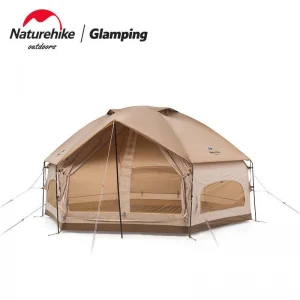
Many friends who have just started camping think that when camping, the weather and temperature remain the same. As long as we pay attention to the changes in the weather and temperature at that time, we will be safe. In fact, this is very idealistic. In practice, we may encounter various situations. Let’s talk about how to deal with rainwater and prevent moisture when it rains.
If you are unfortunate enough to camp in the rain, here are two points to keep in mind. I hope everyone must read it, it can help you survive camping in the rain.
1.Moisture-proof ground cloth that cannot be larger than the tent area.
Moisture-proof floor cloth is a moisture-proof cloth placed under the tent, which can protect the bottom of the tent and prevent the moisture from the ground from passing through the bottom of the tent. But many newbies make this mistake, which is to let the moisture-proof floor cloth extend beyond the bottom of the tent. When it rains, the rainwater will accumulate on the moisture-proof cloth, and then it will flow down under the tent. If the water pressure is too high, it will seep into the tent. If the above situation occurs, it is better not to lay the floor cloth, and the situation may be better.
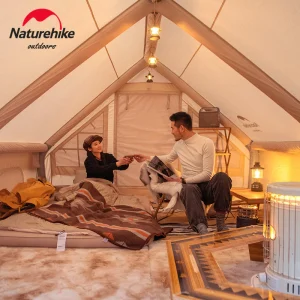
Therefore, remember to choose a moisture-proof floor cloth of the right size. If the ground cloth is larger than the tent, also remember to tuck it under the tent without exposing any ground cloth that may catch the rain.
2.Pay attention to the water leakage of the tent, it is very important to pull the water line.
When pitching a tent, pay attention to whether there are any concerns about standing water on the top of your tent. Even if it is a small place with a small amount of water at the beginning, it may gradually turn the tent into a large basin of water due to the weight of the water. If there is too much water, the tent may be damaged.
This situation is most likely to occur in the extension cloth of the canopy tent. So when you set up your tent, be sure to check that your tent has a good drainage angle.
Pulling the water line is a very common way to strengthen drainage. It means to pull down a corner of the tent with a camp rope and fix it with a camp nail, so that the water on the top of the tent can be drained down to the lowest point. You can also adjust the height of the camp column, adjust the angle of the camp rope, etc. to control the surface of the tent and make it as inclined as possible. Draining water from the tent roof quickly reduces the risk of water leaks in the tent.
How to maintain ventilation and avoid dampness?
The outer and inner tents must be opened. The greater the distance between the inner tent and the outer tent, the more comfortable you will be inside the inner tent. This layer of air between the two tents can have the effect of heat preservation and heat insulation. It works even better if the air movement is good here.
As you can imagine, in summer, your outer tent will be very hot from the sun. At this time, if your inner tent is attached to the outer tent, the heat of the outer tent will be directly transmitted to the inner tent, which will affect the air temperature of the inner tent, and the inner tent will heat up accordingly. However, if there is a little distance between the inner tent and the outer tent, if the air between them is circulated, it is easy to export the hot air, and it will not be stuffy in the tent. Then there is the radiant heat generated by the hot outer tent, and the radiant heat can only be solved by long distance, so I said that the farther the inner tent is from the outer tent, the better