If you are planning your first camping, or you are new to camping, this article will be helpful. So, be sure to read to the end!
How to choose the camp location?
First check whether it is in a dangerous place, such as a low-lying place where water is likely to accumulate, on a drainage path, on an ant nest… Set up tents in these locations and imagine what will happen! But how to avoid them? How to judge these places? Here are some ways to identify them, so that you can try to avoid these places as much as possible.
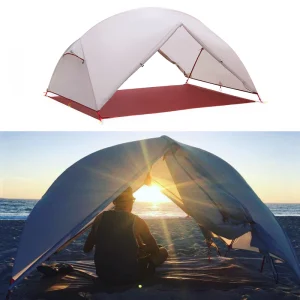
a.Low-lying places / places prone to water accumulation
Direct visual inspection, if you can see the low-lying place with your eyes, then quickly avoid it! It will definitely be a pool of water when it rains.
b.Drainage path
In fact, it is not easy to judge. But if your campsite has drainage, such as a gutter, try to avoid it. Because the gutter is usually at a relatively low point, it will collect a wide area of water, and that flow will usually be quite large, so try to avoid it.
c.Ant nest
Camping activities are carried out in the wild, and it is inevitable that there will be mosquitoes infested, but still pay attention, do not put tents on ant nests. All the ants in the entire ant nest came out of the nest, which is very scary!
Once we encountered an ant nest, the corner of the tent was full of ants, and the backpacks and luggage were also covered with ants, which was very scary and disturbing. But fortunately, the ants at that time were not aggressive, they were very small ones. But some ants will bite people and even bite through tents, which is really exaggerated!
d.Turn away from the direction of the wind
Usually, the main entrance of our tent is always open. If the wind is relatively strong, pour it into the tent, and the wind force of the tent is very large (similar to the concept of a parachute). Even if the wind isn’t strong enough to break the tent, you won’t feel comfortable inside the tent. Many tents are designed with a low and closed back, or even lower the height of the entire tent, which is of great benefit to wind resistance. Trust me, you definitely don’t want to have your tent facing the wind when it’s colder in winter.
e.If it’s sunny, dry, or hot, find shade.
If it is winter or a rainy day, I will choose a place with more sunshine, that is, a place with less shelter and shade. This will keep your tent warm and dry when the sun comes out. Even if it was raining the day before, you can take advantage of any bit of sunlight before closing the tent, then dry the tent, and put it away. This is a very common occurrence. It is like this in the mountains. The sun will come out in the morning, and it will probably rain after noon. If it is a hot summer, I will choose a place with shade to set up camp, which can make up for the shortcomings of the tent’s lack of shading or poor heat resistance. This way you won’t be woken up early in the morning! Especially in summer, the sunrise time is earlier.
f.Stay away from mountain walls.
If your camp has a hillside, first check to see if there are small rocks that fall next to the hillside, if there are, it is a little dangerous. We usually stay straight away from the hillside to avoid any risk of falling rocks and getting hit by them.